Monday, November 8, 2010
Savannah Schroll Guz, On Reading
"Reading, for me, is a completely delicious escape while also an opportunity to reconnect, since my view of the world and my internal monologues are often driven by what I am reading. I love Baroque descriptions, exquisite adjectives, stunning nouns. I’m especially fond of reading psychological descriptions. What does someone else’s internal world look like? This is why I go to Joyce Carol Oates’ work when I need to restock my own ‘word larder.’ There’s an intense beauty to her descriptions of angst (because with JCO, there’s always angst). Also, I return again and again to Günter Grass. I’ve read his work in the original German, but it’s the translations—the really good translations (I know how hard it is to match meaning)—I go back to again and again. My favorites are Tin Drum and The Flounder , translated by Ralph Manheim in 1961 and 1978, respectively (my copies are badly dog-eared). Both are like that really good first shot of bourbon, which seems to brighten and sharpen the look of the world. I seem always to be thinking about reading The Flounder when I’m writing, and conversely, reading any of the above makes me want to get back to writing."
{Savannah Schroll Guz is author of the short story collections, American Soma (2009) and The Famous & The Anonymous (2004), and editor of Consumed: Women on Excess (2005). She divides her online life here and here.}

Friday, November 5, 2010
Andrew Borgstrom, On Reading
"Eating the tail and being the tail and eating the tale and being the teeth. It is only because I consider myself a reader that anyone considers me a writer."
{Andrew Borgstrom resides in the Matted Welcome Desert.}
Thursday, November 4, 2010
Howie Good, On Reading
"I wasn't a reader as a kid. I was way too restless to sit still and read. I did daydream a lot, though, making up stories in which I was generally the hero. I suppose all this imaginative activity contributed to my becoming a writer. It also -- and earlier -- contributed to my becoming a reader. I entered new and better daydreams through reading than I could find on TV or make up on my own. This isn't to suggest that reading for me was or is primarily an escape. It isn't. Rather, it's a kind of liberation from mental and physical contraints. You sit still while reading, but you can go anywhere in your head."
{Howie Good is the author of the full-length poetry collections Lovesick (Press Americana, 2009), Heart With a Dirty Windshield (BeWrite Books, 2010), and Everything Reminds Me of Me (Desperanto, 2011), as well as 23 print and digital poetry chapbooks.}

Wednesday, November 3, 2010
Friday, October 29, 2010
Thursday, October 28, 2010
Saturday, October 23, 2010


Friday, October 22, 2010
cover me with words

Abayomi Animashaun's The Giving Of Pears

Eric Beeny's Snowing Fireflies

Matt Bell's How They Were Found

Kate Bernheimer's Horse, Flower, Bird

Paula Bomer's Baby And Other Stories

Mel Bosworth's Grease Stains, Kismet, And Material Wisdom

Ana Božičević's Stars Of The Night Commute

Blake Butler's Scorch Atlas

Jessie Carty's Paper House

Brian Evenson's Fugue State

Molly Gaudry's We Take Me Apart

Amelia Gray's Museum Of The Weird

Tim Hall's One Damn Thing After Another

Heather Hartley's Knock Knock

Shane Jones's Light Boxes

Bhanu Kapil's The Vertical Interrogation Of Strangers

Michael Kimball's Dear Everybody

Amy King's I'm The Man Who Loves You

Tao Lin's Cognitive-Behavioral Therapy

Kendra Grant Malone's Everything is Quiet

Joseph McElroy's Preparations For Search

Lydia Millet's Everyone's Pretty

Sawako Nakayasu's Texture Notes

Adam Robinson's Adam Robison And Other Poems

Caleb J. Ross's Charactered Pieces

Matthew Savoca's long love poem with descriptive title

J.A. Tyler's Inconceivable Wilson

William Walsh's Questionstruck

Mike Young's We Are All Good If They Try Hard Enough
Thursday, October 21, 2010
Tuesday, October 5, 2010
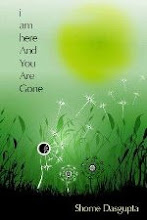
i am here
And You Are Gone

Winner of the 2010 Outsider Writers Press
Fiction Chapbook Contest
Available here.
“Shome Dasgupta writes about young love with a heartbreaking honesty and simplicity that transcends anything I’ve read in recent years. As we follow Jonas and Mary from kindergarten to senior year, we see a range of textual expression that is both innovative and wildly appealing. This book cracks powerful with youthful thunder, black echoes laced tightly with ephemeral innocence. Dasgupta’s debut hits the mark, and leaves one.”
---Mel Bosworth, author of When the Casts Razzed the Chickens (Folded Word) and Grease Stains, Kismet, and Maternal Wisdom (Brown Paper Publishing)
“From the start, I fell in love with this book. Shome Dasgupta takes on perhaps the most common of all subjects—love—and makes it somehow fresh and new. Stunning in its use of form, language and character, i am here And You Are Gone is a delight. The book and its author are remarkable. This is the first you may be hearing from Shome Dasgupta, but I can’t imagine it will be the last.”
---Rob Roberge, author of Working Backwards from the Worst Moment of My Life (Ren Hen Press)
“In i am here And You Are Gone, Shome Dasgupta writes with a sparse and mathematical elegance, creating a system of symbols and spaces with which to describe young Jonas’ growing affection for his friend Mary. Throughout the too-fast years of their youth, the two friends hurtle across what must feel to them like a lifetime, moving like two near-parallel lines approaching the same point, one set so impossibly infinite that they might never reach it together. Still their paths pull close, closer, so close that no matter how we might look we may be unable to divine what unsolvable span it is that at the last separates them–and so perhaps us–from each other.”
---Matt Bell, author of How They Were Found (Keyhole Press)

Winner of the 2010 Outsider Writers Press
Fiction Chapbook Contest
Available here.
“Shome Dasgupta writes about young love with a heartbreaking honesty and simplicity that transcends anything I’ve read in recent years. As we follow Jonas and Mary from kindergarten to senior year, we see a range of textual expression that is both innovative and wildly appealing. This book cracks powerful with youthful thunder, black echoes laced tightly with ephemeral innocence. Dasgupta’s debut hits the mark, and leaves one.”
---Mel Bosworth, author of When the Casts Razzed the Chickens (Folded Word) and Grease Stains, Kismet, and Maternal Wisdom (Brown Paper Publishing)
“From the start, I fell in love with this book. Shome Dasgupta takes on perhaps the most common of all subjects—love—and makes it somehow fresh and new. Stunning in its use of form, language and character, i am here And You Are Gone is a delight. The book and its author are remarkable. This is the first you may be hearing from Shome Dasgupta, but I can’t imagine it will be the last.”
---Rob Roberge, author of Working Backwards from the Worst Moment of My Life (Ren Hen Press)
“In i am here And You Are Gone, Shome Dasgupta writes with a sparse and mathematical elegance, creating a system of symbols and spaces with which to describe young Jonas’ growing affection for his friend Mary. Throughout the too-fast years of their youth, the two friends hurtle across what must feel to them like a lifetime, moving like two near-parallel lines approaching the same point, one set so impossibly infinite that they might never reach it together. Still their paths pull close, closer, so close that no matter how we might look we may be unable to divine what unsolvable span it is that at the last separates them–and so perhaps us–from each other.”
---Matt Bell, author of How They Were Found (Keyhole Press)
Wednesday, September 29, 2010
Ken Baumann, On Reading
"I read in bouts. I haven't seen an end of all potential. There is too much to read, if you're looking. Better to stay blind, be irrational and impatient, and don't hold conditioning as essential to faith. Books have dictated my behavior more than I'd like to admit. Some are very beautiful."
{Ken Baumann is. }
Thursday, September 23, 2010
Linda Olsson, On Reading
"I recently had an e-mail from a friend in Sweden. He told me he had been on his way to work that morning and had happened to be standing next to a young woman in the crowded subway train. She was reading a book and seemed to be completely lost to the world, with tears streaming down her face. As he bent over a little he could see that she was reading Astrid and Veronika, my first novel. The message moved me utterly, of course.
When I was a child living in Sweden we used to call grandmother every Christmas Eve. She lived in the US and it was expensive to make the toll call, so we had to line up prepared to use the short time allotted each one of us. When it was my turn I would press the receiver to my year and wait for the miracle. My grandmother’s voice. Her words in my ear sounding so close, as if she was there in the room with us. I couldn’t understand it. But it was a very short moment. Now, when my grandmother is long gone, I still have her letters. And in them I still hear her voice. See her face. Her words in her driven handwriting still bring out the feelings that we had for each other. I can see her, hear her. And it happens that I am moved to tears when I read them.
Writers are lonely people, I think. I am. My work, if you can call it that, takes place at odd hours, often very late at night, and in complete isolation. I have no colleagues to test ideas on, or discuss problem solutions with. Quality control happens only after the fact, when my manuscript leaves my computer. And I am rarely present when the miracle happens, when my words reach a reader. I do read reviews, of course (I have never believed writers who claim they don’t), but reviewers are not like regular readers. Their reading is work, while I hope that others will read for pleasure. I do get mail from readers and each message is wondrous. My readers, wherever in the world they happen to be, write to tell me that they have been moved by my words. The miracle has truly happened.
I still don’t understand how phones work, though I often rely on my mobile to connect me with those I love. But I am even more intrigued by how the written word works. How can it be that the symbols that I type on my keyboard can instil the feelings that I invest in them in a reader across the world? In many cases in translation, too. If I talk to a person on the phone, then he or she is at least partially present in our communication. But if I read a letter or text message we are communicating entirely in code. We can’t see each other, can’t hear each other. Yet, the other person is there, on my screen or in my hands as I read the words. I can see him, hear him and the letters in front of me have the capacity to move me in some way. Perhaps this fact contributes to the difficulty of making books into films. Readers have already seen the movie and any other version is likely to disappoint.
It is sad to consider that in spite of this extraordinary capacity to communicate that is imbued in the written word, it is so often used to mislead and deceive, and to communicate hateful or frightening messages. But abuse of power seems be present in all cultures, at all times. And the written word has enormous power."
{For more information about Linda Olsson, please visit her website here.}
Sunday, September 19, 2010
Adam P. Knave, On Reading
"If we don't read, we don't grow and learn. It's one of the most important things anyone can do with their time. It's a muscle, and one that needs flexing and building so that we can imagine, dream and aspire to greater and greater things."
{Adam P. Knave is a writer who lives in New York with his cat and can be found here.}
Tuesday, September 14, 2010
Nik Korpon, On Reading
"I read because I write and I write because I read. They’re the same thing, though, so I never do one and I’m always doing another. When the words won’t come into focus, when they remain a nebulous cloud of frustration behind my sinuses, I hide in a book.
I take notes and diagram the structural scaffolding. I grab chunks of beautiful words so that I can steal them away, wedge them into my own work. Then I see a shiny object and forget what I was supposed to steal and the scaffolding implodes and collapses into a pile, the limbs of half-thoughts and shards of inspiration jutting out at grotesque angles. I toss aside the rebar and bricks, slice my fingers on shattered glass and, somewhere in there, lie the words I’ve been searching for. Mangled, ruined, pulsing and oh so lovely. This is how it begins and begins and begins."
{Nik Korpon is from Baltimore, MD. His novel Stay God (Otherworld Publications) will be released in Dec 2010, and his two novellas, Old Ghosts and By The Nails Of The Warpriest, will be forthcoming in 2011. He reviews books for the Outsider Writers Collective, co-hosts the monthly reading series Last Rites, and is a Fiction Editor for Rotten Leaves Magazine. Give him some skin, or danger, or just search and destroy at nikkorpon.com.}
Monday, September 13, 2010
Michelle Blake, On Reading
"I am a lover of books, books as objects, books as solace, books as a mean of escape and empathy and education. I need to have, on my bedside table, at least two books I have not yet started reading. Otherwise, I feel a little panicky, afraid that I will reach out one night into a bookless void.
At the moment, I am doing something I haven’t done in a long time--rereading, very slowly, a novel I already know well, Coetzee’s Disgrace. I am doing this so that I can begin to understand how he accomplished what he did in that book—how he moved his character from monster to saint without one moment of sentimentality, and all within the context of one of the greatest power shifts in the 20th century, the dismantling of apartheid. The author never flinches or backs away from brutality. This is one of my weaknesses as a writer, the desire to smooth things over, and I hope to gain from this book an iota of the courage Coetzee has always seemed to exercise so effortlessly, but never before with such astonishing scope and generosity.
One more thought about escape, empathy, and education: It occurs to me that we think of escape as a cheap and easy thing. But with a novel like Disgrace, while I do get to leave my own irritating life behind, I do not move into an easier world. I move into an infinitely more complex world, if only because the complexities (which I for one tend to minimize in my own life) are illuminated. And, so, I become more educated."
{Michelle Blake has published three novels in the acclaimed Lily Connor mystery series, The Tentmaker, Earth Has No Sorrow, and The Book of Light, about which the NY Times Book Reviewer Marilyn Stasio wrote, "Michelle Blake’s series about an Episcopal priest…stands out for a couple of reasons—besides the essential one of being written with intelligence and grace.” Blake’s fourth novel, Hill Country With Angels, is not part of the mystery series, though it does include an art heist, a psychic, and the promise of redemption. She is now at work on a collection of essays, Grown Children.}
Wednesday, September 8, 2010
Dennis McFarland, On Reading
"When I was a child in grammar school, we were regularly administered 'standardized tests,' and the part I always had the most trouble with was the reading section. You were given a big block of text to read, and then you had to answer questions about it. I never had adequate time to finish, because I read so slowly. Not much has changed. To me, the verb read means 'de-code and file.' The de-coding must be done slowly and sometimes the file cabinet is too full for further data. My entry into the text is always accompanied by reluctance. It’s like exploring a new friendship I feel shy about. And I pretty much require total silence. All this is to say, it’s work for me. Under these circumstances, when it’s good, it’s very good, and when it’s not-good it’s … well, usually aborted."
{Dennis McFarland is the author of six novels. He lives in rural Vermont with his wife, writer Michelle Blake. For more information, visit his website here.}
Sunday, September 5, 2010
Monday, August 30, 2010
Sunday, August 29, 2010
Saturday, August 28, 2010
Sunday, August 15, 2010
Joseph Young, On Reading
"I read so many things for so long that I think my brain said, no more words for now, give me pictures instead. So, I stuffed myself with pictures. After a while my brain said, ok give me words again. Now many of my favorite words are pictures themselves—opaque, dense, not shining their light elsewhere but a light being shone on them."
{Joseph Young lives in Baltimore. His book of microfictions, Easter Rabbit, was released by Publishing Genius in December 2009. His new vampire novel, NAME, can be purchased here.}
Friday, August 13, 2010
Ken Sparling, On Reading
"My dad gave me a copy of Catcher in the Rye when I was fourteen. He said he read it when he was a young boy and loved it. What I felt reading Catcher in the Rye excited and confused and frightened me.
There was swearing in Catcher in the Rye. It was the first time I’d seen the word ‘fuck’ in a book, and it excited me to think this was possible, that someone would be allowed to write ‘fuck’ in a book, and that I would be allowed to read the word ‘fuck’ in a book, and that no one would try to stop me, and that, in fact, my dad had actually given me a book to read knowing that it said ‘fuck’ in it. This confused me. This blurred my understanding of the world in a way that made me understand that there were things possible coming toward me that I could never anticipate. I wanted to go toward these things and feel this blurry confused excitement again and again.
The only book I remember reading before Catcher in the Rye was The 500 Hats of Bartholomew Cubbins. This book also frightened and confused me. I hated the fact that every time Bartholomew took off one hat another one appeared in its place. This drove me nuts. I was scared to death when the king threatened to cut Bartholomew’s head off. It didn’t seem fair. It seemed awful to me that a king would do such a thing. It seemed awful that there seemed to be nothing Bartholomew could do to save his head, no matter how good his intentions were. It scared and confused me to read this book. And yet I went back to read it again and again.
I think I must like to read things that hurt and confuse me. When I think about the best things I’ve ever read, they are things that hurt so much I’ve had to stop reading and go back into the world. And when I get back to the world from these books that throw me back into the world, I feel the pain of the world in a new way, a way that confuses and excites and frightens me.
Somehow, the pain of reading certain pieces of writing seems to help me confront and encounter the pain of the world in a way that makes the pain of the world seem worthwhile. I try not to run away from the pain of the world, but at some point I always do, and often I do it by reading. And then I again have to find some way to escape the numbness that robs me of the pain that makes life feel so good when I don’t run away from the pain of being alive.
Sometimes I do read simply to escape. A lot of times, actually. But sometimes I come across a piece of writing that operates exactly the opposite of the things I read to simply escape the world; a piece of writing that throws me back into the world where I can again feel the pain that I hunger to feel when I’ve found myself with the strength to withstand, and even embrace the pain of the world."
{Contact Ken Sparling here to get any of his Pedlar Press books, including his most recent novel, Book. Visit Ken here to find out about his book Hush Up And Listen Stinky Poo Butt, published by Artistically Declined Press.}
Sunday, August 1, 2010
Jamie Iredell, On Reading
"Reading is, plain and simply, the backbone (or psychobiomaterial, to not be so chordatathropic) of a fully-developed free civilization. Remember that under the three-estate system of European feudalism there was the royal estate (literate), the clerical estate (literate), and everybody else (the illiterate)? People like Joseph Stalin (despite the later Soviet Union's push for a 100% literacy rate) relied on illiteracy to kill 30 million Ukranians, and Mao Tse Tung relied on the ignorance of the peasant class during the Cultural Revolution, during which approximately 40 million died. For all we know Kim Jong Il uses illiteracy now to subjugate North Koreans. But we don't know because there's no fucking writing coming out of there. Here, in the United States of America, we have a program called No Child Left Behind. That program--along with a general demise of readers and an influx of competing 'entertainments' (television, film, video games) in recent decades--encourages a reliance upon one-stop-shop education. Information, like, for example, what's found on websites, is encouraged. Not literacy or critical thinking. Anyone can tell you that the sky is blue, but only someone who has thought about what they've read, and read some more, can talk about the oxygen, nitrogen, and trace elements that scatter light to reflect the color blue. Shit, only someone who's literate can tell you that there's no such thing as color, only light spectra. There isn't even journalism anymore. Everyone's a pundit, whatever the fuck that means these days. As far as I can tell, all it seems to mean is that they have a pretty angry opinion about assholes like Lyndsey Lohan. So, as the whole shithole comes to a collapsing bang, don't think to thank the writers you're not reading. Not that I'm worried about you 'thinking' or 'reading'. And by 'reading' I don't mean Stephanie fucking Meyer, Charlaine fucking Harris, or--jumping Jesus--Stephen fucking King."
{Jamie Iredell is the author of Prose. Poems. a Novel. (Orange Alert Press, 2009), and The Book of Freaks (coming in December 2010, from Future Tense Books). Visit his blog here.}
Saturday, July 31, 2010
Rachel Kendall, On Reading
"There’s nothing better than a good book, a cocktail in hand, a cigarette smouldering in the ashtray, a comfortable chaise longue and... in fact, forget all that, just give me a good book."
{Rachel Kendall’s short story collection The Bride Stripped Bare was published by Dog Horn Publishing. Her novel The Blush is due to be published in 2012. She is the founder of ISMs Press and edits the literary zine Sein und Werden.}
Friday, July 30, 2010
Paula Bomer, On Reading
"Like many people of my generation, I was taught to read in the first grade. My teacher, Miss Buzolich, was a wiry, elderly woman with a grey, permed helmet of hair and glasses, who wore respectable shirt dresses and had a penchant for spanking. She also barked out her lessons. That said, she liked me, as I was a good, well behaved student. Fittingly, my earliest memories of reading coincide with my earliest memories of experiencing excruciating, debilitating anxiety. I was intensely afraid of Miss Buzolich and on occasion became unable to move or speak in fear of her rages. Sticking my nose in a book and being thoroughly transported to another world was a wonderful antidote to the terror of the classroom.
I learned to read quite easily and remember being terribly bored with the learn-to-read books. They came in different colors for different levels, yellow and orange being beginner books, green and blue and purple becoming more advanced. I graduated to real books quickly. Our family thought of reading as a privilege and a pleasure, not as a chore. One of the great joys of my childhood, met with tons of excitement, was going to the library before our summer vacation in a cabin on Lake Michigan. We were allowed to check out many books, as many as we wanted, and this was the equivalent to being let lose in a candy store. Once we were at the lake, we swam, played in the sand, and read endlessly.
In high school and college and thereafter, I read a great deal. I read for the pleasure of it still, the being deeply involved in other worlds, the joy of imagining a whole alternate reality in my head from the words on the page. I learned to read critically, as well, which I enjoyed for its quite different feeling, that of doing pushups for the brain, as reading critically felt muscular and vigorous. I think 'big' readers, people who read a lot, often do so to escape the world around them. I feel this is a great example of our faults being tied to our strengths. Social anxiety can be ignored when your nose is in a book. The actual act of reading is almost against being with people.
In high school, English classes and Creative Writing classes were my favorites. I loved studying Shakespeare, loved Catcher in the Rye and Great Expectations and the short stories of Flannery O’Connor. I think it was junior year I had a feminist, quite possibly lesbian, teacher where we read Chaucer alongside Alice Walker. My senior year I lived in Spain, and read Gabriel Garcia Marques, Borges, Cortazar, Puig and others in Spanish. It was in Spain where I also first read Hemingway. On my own, I had read all the works of Toni Morrison and it was during my teens and early twenties that I was interested in the modernist tradition, reading lots of Faulkner and other 'languagey' writers. That said, in college, I was obsessed with Jean Rhys and Anaïs Nin’s diaries. I didn’t study literature in college, I studied psychology and anthropology, with a few literature classes thrown in as electives.
After college, I moved to New York and worked in book publishing. I had to read books I would never have read otherwise and had to read two of them a week working as a foreign scout. I didn’t manage this job for very long. It broke my heart not to read what I wanted, not to read books that mattered to me, as most of what I read wasn’t very good. A large part of my life was taken away from me. I became seriously anxious and depressed. (And yet I did discover some contemporary writers who were wonderful, for instance, when I read The Gold Bug Variations by Richard Powers and recommended him highly to all of our European clients.)
I vividly remember quitting the scouting job and becoming a bartender. Suddenly, almost miraculously, the anxiety and depression lifted. I had more free time and that time I could spend reading whatever I wanted. I had time to read David Copperfield. I read Madame Bovary, Chekhov, Lolita, Paul and Jane Bowles. I read lots of Denis Johnson, huge amounts of Philip Roth. I reread Flannery O’Connor’s short stories as well as her two short novels. I reread Jean Rhys. And then I read Mary Gaitskill’s first story collection, Bad Behavior, and that was when I knew: I wanted to do this, I wanted to be a writer. I had been writing stories since high school, but I had never articulated, not even to myself, what it was I wanted to do. Reading Mary Gaitskill changed that. I applied to graduate programs in Creative Writing.
Reading is intricately tied to what I consider my vocation. I may read less than I did when I was younger, but I still more or less read daily, often for hours. Right now, I’m deeply engrossed in a series of books called the Cazalet Chronicles, by Jane Elizabeth Howard, the woman for whom Kingsley Amis left his wife. In their entirety, they consist of nearly 2000 pages. I am halfway through and in love—I just bought her biography—and a little perplexed as to why some of her work is out of print. This is maybe one of the reasons why I read-to experience love, joy, hilarity, pain, fear, anguish, hate-but to do it safely within my imagination. Maybe being a reader is in some ways an act of cowardice, because experiencing the emotional lives of characters is not as risky as experiencing them in real life. Or one could explain it more generously by calling reading a safe way of expressing voyeuristic tendencies. I have no doubt that, quite simply, mankind is wired to tell and listen to stories.
I have gone through times of despair where I wish I had chosen any other thing to do with my life, anything not so lonely. Reading a lot does not give one very great social skills. It’s sort of a self fulfilling prophesy-you read a lot to escape the world, and the less you are in the world, the less good you are at being in it, which makes you want to escape, and so on and so forth. And at other times, times like now, I am at total peace with being a reader and a writer. I’ve made my bed, so now I lie in it, with a book, of course."
{Paula Bomer is the author of the forthcoming short story collection, Baby And Other Stories (Word Riot Press, Dec 2010). Her fiction has appeared in Open City, Fiction, The New York Tyrant, The Mississippi Review and elsewhere. She's the co-publisher at Artistically Declined Press and the supervising editor of the literary journal, Sententia. Visit her website here.}
Thursday, July 29, 2010
Johannes Göransson, On Reading
"I read about things that fascinate me. Of course they can fascinate in many different ways, many of them unwholesome, possibly even detrimental. Right now I'm translating Swedish poet Aase Berg's second book, Mörk Materia (or Dark Matter, due out in translation from Black Ocean next year). Here's something I just translated (provisional):
'The tentacle city glitters in a chain of streetlights and flicker globes. There pinheads jump around and pick sticky pionees. But Saskia in silk sinks down in the Ylajali River’s skin-blue whirls. The moraine-eels suck her stretched-out [inflated?] arteries. Moraine eels in a wreath of unmentionable water angles.'
That's just my rough draft. But that's what I'm reading this afternoon in Indiana. If anyone is interested, in August, I'm starting a new blog with some friends - it's called Montevidayo. It will be dedicated to reading."
{Johannes Göransson is the author of several books of poetry/prose and the translator of several books of Swedish poetry. He is the co-editor of Action Books and the online journal Action, Yes. He teaches at the University of Notre Dame in Indiana.}
Wednesday, July 28, 2010
Aimee Bender, On Reading
"Reading. First off, it's incredibly intimate. Me, and the writer, meeting on the page. Paul Auster has a great line, something like 'writer and reader make the book, both' and I think that's a beautiful way of stating it. There's a duet in play. Part of my job, in reading, is to try to take in what the writer has put on the page, to bring enough of myself to it so that something activates.
Reading is often a non-linear experience for me. I'll race ahead a few pages to get a tiny sense of what's to come if I can't stand waiting. Then I'll go back, slow myself down, sometimes going extremely slowly, to get there. When I'm reading a book I love, I'll often read the lines twice as I go to take them in. I slow myself down again, to make sure I'm aware of what I'm reading. Sometimes it's too much. It depends on my general level of concentration. Also, my eye darts around, going to the bottom of the page, the top, reversing, back forward.
I did a map of this once for the journal Ecotone, it's the third map:
'Three Maps' (Ecotone, Volume 2, Number 1: Fall/Winter 2006).
If I'm reading a book where the language doesn't really move me, I'll read very fast, and sometimes it's nice to take a break like this and read a thriller or a cop book just to read for plot alone, because reading as a writer is often a painstaking process. A very meaningful one, but a slow one. It took me months to read Marilynne Robinson's book Home. A couple pages a day, sometimes.
That said, I also read for how the words look on the page, and Tender Buttons by Gertrude Stein is a joy to read because it's so strange and funny and fresh and exciting, but also because it looks so great. The words just look really good together."
{Aimee Bender is the author of four books: The Girl in the Flammable Skirt (1998) which was a NY Times Notable Book, An Invisible Sign of My Own (2000) which was an L.A. Times pick of the year, Willful Creatures (2005) which was nominated by The Believer as one of the best books of the year, and The Particular Sadness of Lemon Cake (2010). She has received two Pushcart prizes, and was nominated for the TipTree award in 2005, and the Shirley Jackson short story award in 2010. Her fiction has been translated into ten languages. For more information, visit her website here.}
Tuesday, July 27, 2010
Sumanth Prabhaker, On Reading
"I know I must have read at least some books when I was little, because the public library in our city had really good air conditioning during the summers, so we were there all the time. My parents would sit in adjacent armchairs, reading periodicals and different newspapers, and my brother and I would be told to wander around until it was time for lunch. I know I read a lot because there wasn't much else to do in the library, at the time, and I know I loved many of those books, but I have very few memories of actually reading -- actually going up to a shelf and selecting something and finding a clean place to sit and read. It's really only the stories that I remember, like I just at certain points added their content to my brain.
When I remember first being very conscious of the act of reading were the few times my parents took me to visit their parents in India. Down the road from my father's parents' house was a little lending library made of scrap aluminum siding, three walls and a kind of roof, and the owner sat outside on a wooden stool. My father, a stranger to jetlag, would get up early during these trips and eat idlis at the table with his parents while my mother got herself out of bed, and my brother and I would walk down the dirt road and see what was to be had at the lending library that day. You could probably fit three full-sized people in there if they all stood facing the same direction. I don't know how this can be true, but I remember using empty Coke bottles in some kind of transaction for the books I got. I remember getting these books and taking them back to the house with me and I remember reading them way up close to the electric fan, which my grandparents brought out specially for me during these visits: the Famous Five and Secret Seven, Asterix and Obelix, and as much Tintin as my arms could carry.
Before they were collected in the hardcover editions seen in most bookstores now, Tintin comics were oversized and thin and a little unwieldy to hold; they were always there, on the walk back to my grandparents' house, and spread out on the carpet before me. You had to hold them with both hands to get a good view of the page, and the layout of the panels defied the easier left-to-right reading of the books I kept busy with at my hometown library. They were my favorite things. During the schoolyear, my father sometimes traveled to India on his own, and Tintin was part of what made it so exciting and dramatic for me when he returned home -- he would open his big suitcase on the floor and make separate piles of the treats he'd brought back for each of us, and at some point there would be a bright new comic for me, buried beneath some shirts. For a while it seemed to me that there was no other way to access these stories than by flying across the world and exchanging currencies.
The cities in India all have new names now, and the lending library has since shut down or moved, and the whole Herge library can be purchased online and often locally. I still prefer Tintin comics to pretty much everything else, but I think I was very lucky to have been introduced to them in this particular way, with the dirt road and possible Coke bottles. They were books that required work both to get and to consume, which made the story of reading them important to the story within them, or maybe the other way around."
{Sumanth Prabhaker is the founding editor of Madras Press, a non-profit publisher of individually bound short stories and novella-length booklets that donates its proceeds to charitable organizations selected by the authors. His novella A Mere Pittance was among the inaugural titles to be released last winter, benefiting Helping Hands, a program that trains capuchin monkeys to become live-in helpers to people with disabilities. For more information, visit Madras Press here.}
Monday, July 26, 2010
David Barringer, On Reading
"A book is the delivery system for a hallucinogen you ingest through the eyes and digest in the mind. Reading allows one imagination to taste the inside of another."
{David Barringer is the author of There's Nothing Funny About Design, American Home Life, Johnny Red, and Emigre 68: American Mutt Barks in the Yard. Visit his website here for more information.}
Sunday, July 25, 2010
Bhanu Kapil, On Reading
"I read in order to emigrate. To not be there anymore. To leave the life I am in, if that is not too boring and repetitive a way to say it. It is boring to emigrate. There are airports, for example, and then a weird stretch some way in when it is too late to go back. In such a stretch now, and with family responsibilities that I never quite imagined - - I find myself reading poetry, or trying to read poetry, that is more beautiful than my actual life. I read the poetry of Dolores Dorantes, in translation by Jen Hofer in 'the red book.' I read out of the sorrow that comes over immigrants, all immigrants perhaps. Economic sorrow? Social sorrow? Anxiety that does not have a commercial antidote? I don't know. Note to self: Find out what is in other people's hearts. Start with my own heart. To summarize: I read in order to be a writer in the time I am in, which is a closed time. I read to open myself to time, which is the time that opens in turn to writing. I read to flee taut death; to embrace wet or sinking deaths instead. This probably is not making an ounce of sense. I read because it is all I have. It is the only way I know back to writing, other than an obliterating love."
{Bhanu Kapil is the author of four prose/poetry books, most recently one that doesn't exist: Schizophrene, forthcoming from Nightboat Books in Spring 2011. She teaches at Naropa University and Goddard College. Visit her blog here.}
Wednesday, July 21, 2010
Dawn Raffel, On Reading
"I like reading aloud. It's how I write, and if I'm really enjoying a book, I'll read a few pages aloud so I can absorb its cadences. I loved reading aloud to my children. And I love re-reading. The best books do not begin to reveal their secrets to you until you have read them two or three times."
{Dawn Raffel is the author of three books, most recently Further Adventures in the Restless Universe (Dzanc). She has recently completed a memoir in vignettes. Visit her website here for more information.}
Wednesday, July 14, 2010
John Madera, On Reading
"The Whatness of Our Whoness: On Reading
In this land of bilk and money, where the snares of immediacy (of self-gratification, communication, data mining, matchmaking, etc.) may sometimes fool us into thinking that we’re getting closer, that we’re finally nesting within the intimacy we crave, that we matter, somehow, to someone; that it is, after all, a small world; where technological marvels with their ringing bells and screeching whistles have stunned us into a state of wow, causing us to say 'awesome' so frequently it’s lost all meaning; where apathy in its various forms is the new cool; in this land of I, me, mine, this land where time is money and money is the only thing that matters, the act of reading from a book might just be a singular waste of time, or it might be one of the most life-affirming acts, the continuum where we discover, as Joyce wrote in Ulysses, the 'whatness of our whoness'.
My reading habits have usually been disorderly, no, chaotic, difficult to pin down, never falling into any consistent approach, or system, or school of study; more improvisatory, a peculiar kind of going with the flow (a flow whose currents flow back to the past and forward to the future) with my, admittedly, sometimes fleeting interests, or in connection with some project I’m working on, e.g., research for a story I’m crafting, or reading works within a particular genre I’m also working within like, for instance, the year I read approximately seventy-five books of fantasy when I was working on one of my own; but on the whole my reading has been catholic and wanton, if I may be allowed to have those two words be kissing cousins. That said, my reading has, within the past few years, become more intentional, focused, and, I hope, purposeful. For instance, much of my reading last year consisted of reading and reviewing contemporary works of fiction, concentrating specifically on the literature published by independent presses, of which I felt produced, and I still feel produces, the fresher, more ambitious, more accomplished, and, at times, even revelatory work in literature today. However, whenever I encountered a contemporary work that was weak—and the lion’s share of that weakness was usually found in the occasional book I’d read from the major presses, or from the internet’s ever-proliferating, self-reflexive, self-congratulatory, sloppy, and solipsistic websites, and especially in the submissions pile I was reading from as a fiction editor—I would turn back, and some would say, turn back the clock, to earlier works, and find myself immersed in sentences that sung almost operatically and virtuosically, and bemoan the sad and sorry state of literature today. I’ve written about this before, but it’s important to once again note, that this notion, that is, that there was a golden age or ages of literature, is, of course, a fantasy, and a shortsighted one, in fact, since any kind of surface study of any era would reveal that it contained a similarly disproportionate level of mediocre work. At the same time, I have to acknowledge that there are so many contemporary writers who are producing work that is ambitious and challenging, that explores language with great creativity, adventure, rigor, and intelligence. So I seesaw, no, I thumb the scales sometimes to privilege past eras, but I also pendulate, going back and forth between the past and present. I feel, though, that I may be going back more than I will forth for the next long while. The more I read of the recognized literary masterworks, the more I see how contemporary literature is indebted to the works of the past, and, sadly, how often it falls short. It’s no grand revelation, but it does raise some questions, namely, how important is it for me to read a contemporary work of literature if I haven’t read the work from which it was most certainly derived, or would not have existed if said work was not produced. And as I realize this, I also recognize the vast gaps of my understandings of the interconnections, borrowings, ideas, within the history of literature, and this, in turn, adds to my ever-present anxiety about all I want to, need to, and should read.
Yes, I love to read and to share what I’ve read; and I also love to hear what others have read and are reading. Though aware of the many distractions competing for our attentions, diminishing our already tapped time to simply be, to enjoy the sound of the 'infinite great fall of rain' (as Joyce wrote in Ulysses) instead of tap-tap-tapping away at some keyboard, I’m always surprised to talk to someone who isn’t reading anything at the moment or hasn’t read anything in a while, or who, worst of all, isn’t worried about it. The surprise is even greater when that person happens to be a writer, and you’d be surprised by how many there are who aren’t reading, and if they are reading, they are usually reading their peers and contemporaries (a rather narrow menu for anyone with any kind of real appetite for invention, ambition, and creativity, for getting lost in a lacuna of language), and many of whom think that Hemingway is the only way, or that anorectic prose is somehow more evocative, relevant, insightful, or whatever. Though I certainly love cutting, bone white, crisp language, I also love luxuriant prose full of exposition, metaphor, lyricism, essayistic asides, etc., writing that utilizes the full resources of language. How rare it is to find it even in poetry.
Language, for me, comes from language, and ideas come from ideas, so I can’t imagine not reading books, for me the best source of language and ideas; they are a kind of food, an energy source, and, yes, one means of discovering, questioning, fracturing, critiquing the what of who I am and the who of what I am, of what and who I was and may become."
{John Madera's work is forthcoming in Conjunctions, The Believer, Rain Taxi: Review of Books, The Review of Contemporary Fiction, and Corduroy Mountain. His fiction has appeared in Opium Magazine, Featherproof Press, elimae, Everyday Genius, ArtVoice, Underground Voices, and Little White Poetry Journal #7. A member of the National Book Critics Circle, his reviews have appeared in The Brooklyn Rail, Bookslut, The Collagist, DIAGRAM, Fiction Writers Review, Flatmancrooked, The Millions, The Prairie Journal: A Magazine of Canadian Literature, The Quarterly Conversation, Rain Taxi: Review of Books, New Pages, Open Letters Monthly, The Rumpus, Tarpaulin Sky, Word Riot, and in 3:AM Magazine. He is editing a collection of essays on the craft of writing (Publishing Genius Press). He edits the forum Big Other and journal The Chapbook Review. Former fiction editor at Identity Theory, he is senior flash fiction editor at jmww. His monthly column, “A Reader’s Log(orrhea),” may be found at The Nervous Breakdown.}
Sunday, July 11, 2010
Christopher Kennedy, On Reading
"When I was ten, the northeastern United States experienced 'the great blackout.' It was the peak of the Cold War. Everyone’s thoughts ran toward the notion of an attack by the Soviet Union. My mother got me out of bed. She said we were going to her friend’s house, a woman she worked with whose home, though modest, had a fireplace. I remember walking into the house, past a small table, toward the flames that illuminated the living room and gave off a comforting heat. On the table was a book. A paperback. Books were scarce in my home, and no book I’d ever seen had a cover image like this one: a man with a shield in one hand, a woman’s head in the other. He held the head by the hair. But this wasn’t a normal head of hair. It was made of snakes. I stopped and stared at the image of Perseus holding Medusa’s decapitated head, transfixed. My mother’s friend broke the spell by asking me if I’d like to look at the book. I said yes, picked it up, walked into the living room, and lay down in front of the fireplace.
I forgot about the possibility that the world was coming to an end. I was too busy discovering a different world. There was Zeus and Hera. There was Achilles and Hector. There was Jason and the Argonauts. I was so absorbed in this world that I had what I would now call a transcendent experience. At the time, I just knew that I wasn’t afraid any more.
When the blackout was over, we said our good-byes and prepared to go home. My mother’s friend asked me if I wanted to take the book with me. It was her daughter’s, but she knew she would want me to have it. I was ecstatic and slightly guilty. How could anyone part with this? I took it. For the next few weeks I did nothing else in my spare time but read the book. There was Odysseus and Oedipus. There was Paris and Helen.
That book, Edith Hamilton’s Mythology, changed me in some elemental way. It gave me hope. For all I know it saved my life. My father had died a few years before. My mother was incapable of raising me on her own. I was on the cusp of turning from good student to juvenile delinquent. I did go down a path toward self-destruction, but I had something to take with me, and I have no doubt that book and the ones that followed, kept me from self-obliteration.
A few years after that night, I found out from my mother that her friend’s daughter had killed herself. I thought of the book. I knew it was ridiculous, but I thought maybe she’d done it because she gave it up. I thought she had sacrificed herself to save me. That’s how much I believe in the power of books."
{Christopher Kennedy is the author of three books, Encouragement for a Man Falling to His Death (BOA Editions, Ltd.), which received the Isabella Gardner Poetry Award in 2007, Trouble with the Machine (Low Fidelity Press), and Nietzsche's Horse (Mitki/Mitki Press). A fourth book, a collection of prose poems, Ennui Prophet, is due from BOA in 2011. His work has appeared in numerous print and on-line journals and magazines, including Ploughshares, The Threepenny Review, Slope, Mississippi Review, and New York Tyrant. One of the founding editors of the literary journal, 3rd Bed, he is an associate professor of English at Syracuse University where he directs the MFA Program in Creative Writing.}
Saturday, July 10, 2010
Gina Frangello, On Reading
"I am among the contingent to whom reading was like a road map to other possibilities, other futures. Like most people in the world, I come from an insular place--in my case among the urban poor, in a homogeneous Italian neighborhood of Chicago circa the 70s and 80s--where there seemed to be one way of doing things, one future offered, especially to girls. Reading was the secret fire that promised this was not so: that there were as many ways, as many potential adventures and choices as there were books on the shelves of a library. I read for all the usual reasons: I was an only child and often alone, longing for entertainment and company; I wanted to escape my environment; I wanted to feel the sort of profound emotional and psychological understanding that so often eludes children in real life, yet can be found on the pages of a novel. Yet while it sounds strange, although I have also written fiction for as long as I could read, I never read 'because I wanted to be a writer.' I tell my students constantly that in order to write, you must read passionately. But in truth, there are so many other reasons to read that this should be a redundant thing to tell any writer. Reading is an eternal dialogue with the rest of humanity; we read because it enriches us as human beings on every possible level. The fact that it also benefits our own writing is profoundly true, yet seems to me quite secondary as a motive."
{Gina Frangello is the author of the short story collection Slut Lullabies (Emergency Press 2010) and the novel My Sister's Continent (Chiasmus 2006), as well as the Executive Editor of the independent press Other Voices Books and fiction editor of the popular online literary collective The Nervous Breakdown. She has contributed nonfiction, book reviews and journalism to such publications as the Chicago Tribune, the Huffington Post and the Chicago Reader. Her novel, London Calling, will be released next year, and she can be found online here.}
Friday, July 9, 2010
Anthony Doerr, On Reading
"When you’re falling into a good book, exactly as you might fall into a dream, a little conduit opens, a two-way, extra-dimensional tunnel between a reader’s heart and a writer’s, a passageway that transcends the barriers of continents, generations, and often even death. When you’re engrossed in a book, you can shed the material complications of your body in a sentence and become the opposite sex; you can be six years old or seventy-six; you can be a Japanese sailor or an Indian surgeon or a Martian explorer; you can be Ishmael, or an oversized, perplexed cockroach.
You read for a half hour, an hour, an airplane flight. Then you look up. Your hand is cramped; your leg is asleep; time has mysteriously compressed. And here's the miracle: you’re different. You’ve changed. You can never go back to being exactly the same person you were before you disappeared into that book."
{Anthony Doerr lives in Boise, Idaho. He’s the author of three books: The Shell Collector, About Grace, and Four Seasons in Rome. Doerr’s fiction has won three O. Henry Prizes and has been anthologized in The Best American Short Stories, The Anchor Book of New American Short Stories, and The Scribner Anthology of Contemporary Fiction. His work has been translated into eleven languages and has won awards including the Rome Prize, the New York Public Library’s Young Lions Award, the Barnes & Noble Discover Prize, a Guggenheim Fellowship and the Ohioana Book Award twice. His fourth book, a collection of six long stories titled Memory Wall, was published by Scribner in July 0f 2010. Visit his website here or follow him on Facebook here.}
Friday, July 2, 2010
Matthew Simmons, On Reading
"For the last few months, I've noticed that I've been unable to finish books. Unable to focus on reading. I can spend a little time reading poetry here and there, but reading myself to sleep, and reading on lunch breaks, and reading on buses, and reading away my Saturday afternoons? Not happening. Not concentrating. Not retaining. A short story here and there. No novels beyond the first twenty pages—even when I am, for the most part, enjoying them. And because I'm not reading much, I'm not writing much. And because I'm not reading much, I feel really out of sorts. Disconnected.
I know this won't last forever, and that soon I'll go on a reading tear. I'm not sure what will trigger it. I wish I did.
Because not being able to read sucks. That's what I have to say about reading. Not being able to read sucks."
{Matthew Simmons lives in Seattle with his cat, Emmett. He is the author, most recently, of the novella A Jello Horse (Publishing Genius Press, 2009). He will publish a chapbook (The Moon Tonight Feels My Revenge) in 2010 and a collection of short stories in 2011 (Happy Rock), both from Keyhole Press. He is a regular contributor to HTML Giant and the interviews editor for Hobart. More information can be found here.}
Subscribe to:
Posts (Atom)